Understanding cetacean language is only the beginning
Will an entangled whale be able to request an interpreter? How can we provide reliable translation services for nonhumans?
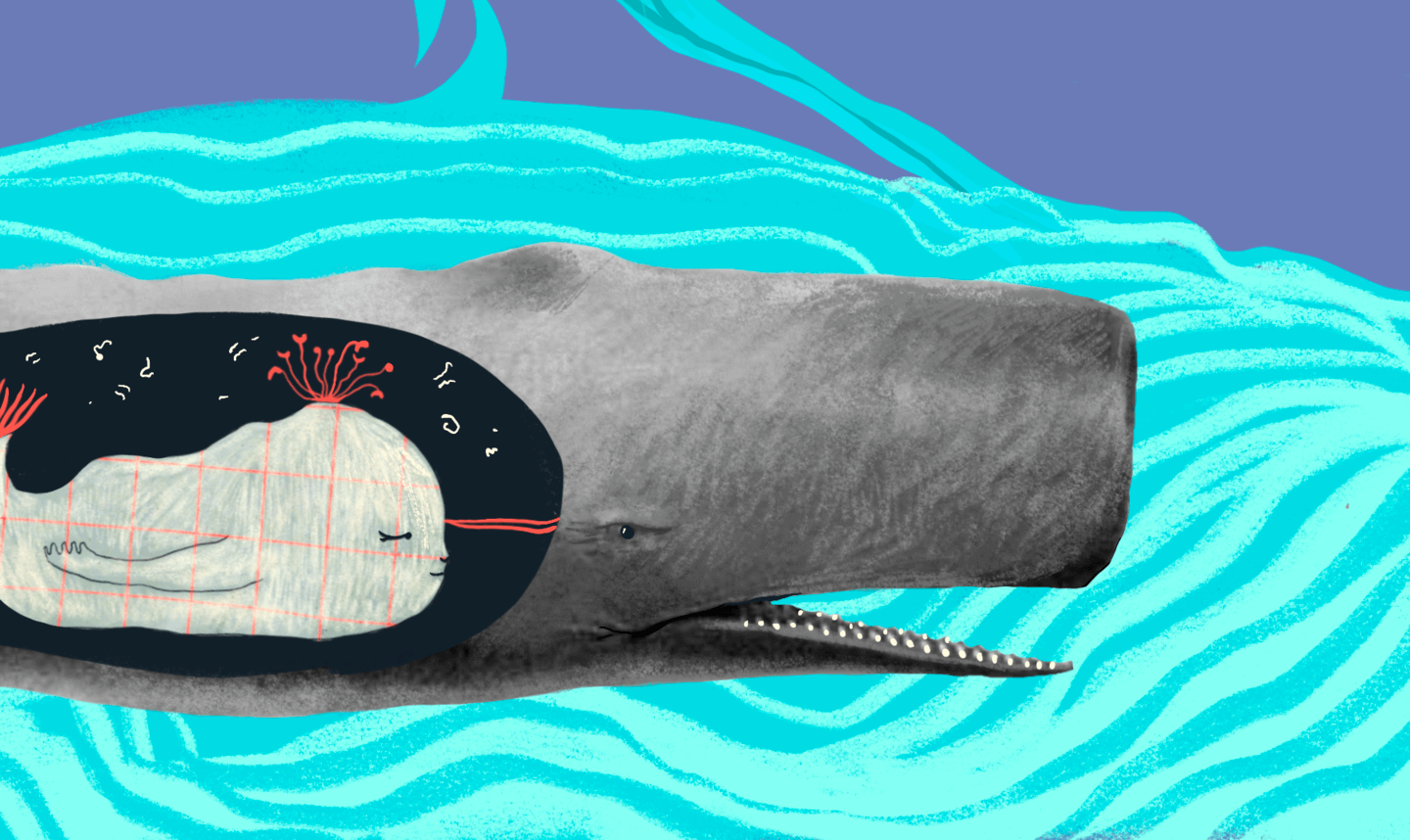
In recent years, the possibility of “decoding” the communication systems of nonhuman animals, particularly cetaceans, through AI-reinforced research has attracted much public and media attention (see, for example, Project CETI, Whale-SETI, and Earth Species Project). Increasingly widespread and networked hydrophone systems in the oceans afford a radically different understanding of whale bodies than the one developed over centuries of commercial whaling. Humans now have access to whale voices 24/7 and are beginning to get a glimpse into their complex cultures. Whales are no longer just “wild animals” to be watched or hunted. They are recognized as members of sophisticated communities and, crucially, as climate refugees migrating through various legal jurisdictions.
Research on cetacean communication often dovetails with discussions around multispecies justice: a system that accounts for the safety, needs, and livelihoods of thriving human and nonhuman communities. But can we talk about multispecies justice without talking about communication and translation rights? Justice seems unachievable in an environment where participants speaking mutually unintelligible languages cannot communicate with one another; such a breakdown of communication would likely result in unfair outcomes and lack of equal access to legislation for all.
But can we talk about multispecies justice without talking about communication and translation rights?
Given recent developments in marine bioacoustics, we are now at a stage where we need to consider the implications of communication for multispecies justice. Today, a great deal of energy and funding is devoted to the possibility of understanding what a cetacean might be saying. And if we manage to achieve this aim, even more energy and money will have to go into securing their translation rights—ensuring, for example, that an entangled humpback whale will be listened to, understood, and helped accordingly; that a captive beluga will have the right to an interpreter; or that a lost and stranded orca calf will be reunited with its own pod and not some other group that speaks a different dialect. As far-fetched as these proposals may sound, they are the logical ethical consequences of being able to understand cetaceans, and they parallel civil and linguistic rights invoked for humans in similar situations. Without a proper infrastructure, we risk having to stand by with our hands tied, even though someone, somewhere on earth will have the ability to translate for the whale in distress.
Translation is often regarded as an instrument of “bridge-building” between nation-states, between authors and readers, and between various agents in political, economic, social, and cultural domains. It carries an aura of cooperation, mutual understanding, even peace-making—naïve as such descriptions may sound considering the role played by translation in historical and contemporary processes of colonization. For those moving into multilingual and multicultural spaces, whether by choice or by necessity, translation (written) and interpreting (oral) are lifelines. However, based on more than three decades of experience in translation and interpreting studies, I can affirm that, globally, we are nowhere near providing comprehensive translation and interpreting services for people in dire need of communication in hospitals, police stations, or courts. Public interpreting services are subjected to constant budget cuts, and the multiplicity of human languages and dialects makes it difficult to find interpreters with the right language combinations. Remote interpreting technology (telephone or video) often fails, leaving all parties stranded. Translation apps are inadequate for dealing with complex matters and downright dangerous in their limitations and mistranslations, especially for minoritized languages. Most importantly, unconscious bias and racism, the ongoing legacies of imperialism and colonialism, are rampant in institutions, discouraging healthcare staff or police from calling for an interpreter in the face of obvious need.
What will we do if we begin to understand cetaceans and are not able to offer them practical, accessible, and affordable ways of being understood?
Are we really hoping that things will be better organized for nonhumans? What will we do if we begin to understand cetaceans and are not able to offer them practical, accessible, and affordable ways of being understood? Could cetaceans benefit from a globally networked translation and interpreting system, for instance? They are, by their very nature, transnational; their annual migration routes traverse multiple borders and recognize none. As the global climate crisis intensifies, they are venturing beyond their twentieth- and twenty-first-century habitats. Gray whales have crossed into the Atlantic once again, after being exterminated there early in the eighteenth century. Grays and humpbacks are climate refugees in the Arctic, venturing further north and mingling in the same waters as belugas and bowheads. Narwhals in the Canadian Arctic are facing predation by killer whales. How could this mobility impact the translation rights of whales? When things go wrong, who will bear the responsibility for providing interpreting services?
Today there is much promising work around the legal personhood/selfhood of non-human entities ranging from forests, mountains and rivers to whales and dolphins. I would argue that such legal personhood/selfhood should go hand in hand with communication rights. In an ideal world, an emphasis on interspecies communication should include some degree of global planning, so that the issues of infrastructure and attitude that currently hinder the provision of satisfactory translation and interpreting services for humans will not be even more acute when it comes to nonhumans. And perhaps such planning could have a positive ripple effect on language services for all life forms, including humans.
At the moment it is tempting to focus all efforts on “cracking the code” of cetacean languages, but we also need to start thinking about what will come next, about how future two-way communication can be enabled and sustained, and about the resources, agents, institutions, and technologies needed to make this possible. Most importantly, who will be the translators and interpreters in human-whale encounters? I am asking “who” and not “what” deliberately—and not only because of the seemingly inevitable and similarly complicated debates on the legal personhood/selfhood of AI on the horizon. In our increasingly disembodied world, the physical presence and immediacy of translators and interpreters carries particular value for understanding the direct physicality of the experiences of another being, whether human, whale, or even barnacle! Only with this kind of embodied intimacy can our current efforts to understand cetacean communication systems reach their ultimate goal: to give voice to the more-than-human.

