Planetary politics begin with sensing agency
Recognizing planetary agency—the world-shaping impacts of microbial shifts, tectonic movements, and everything in between—is key to building effective institutions.
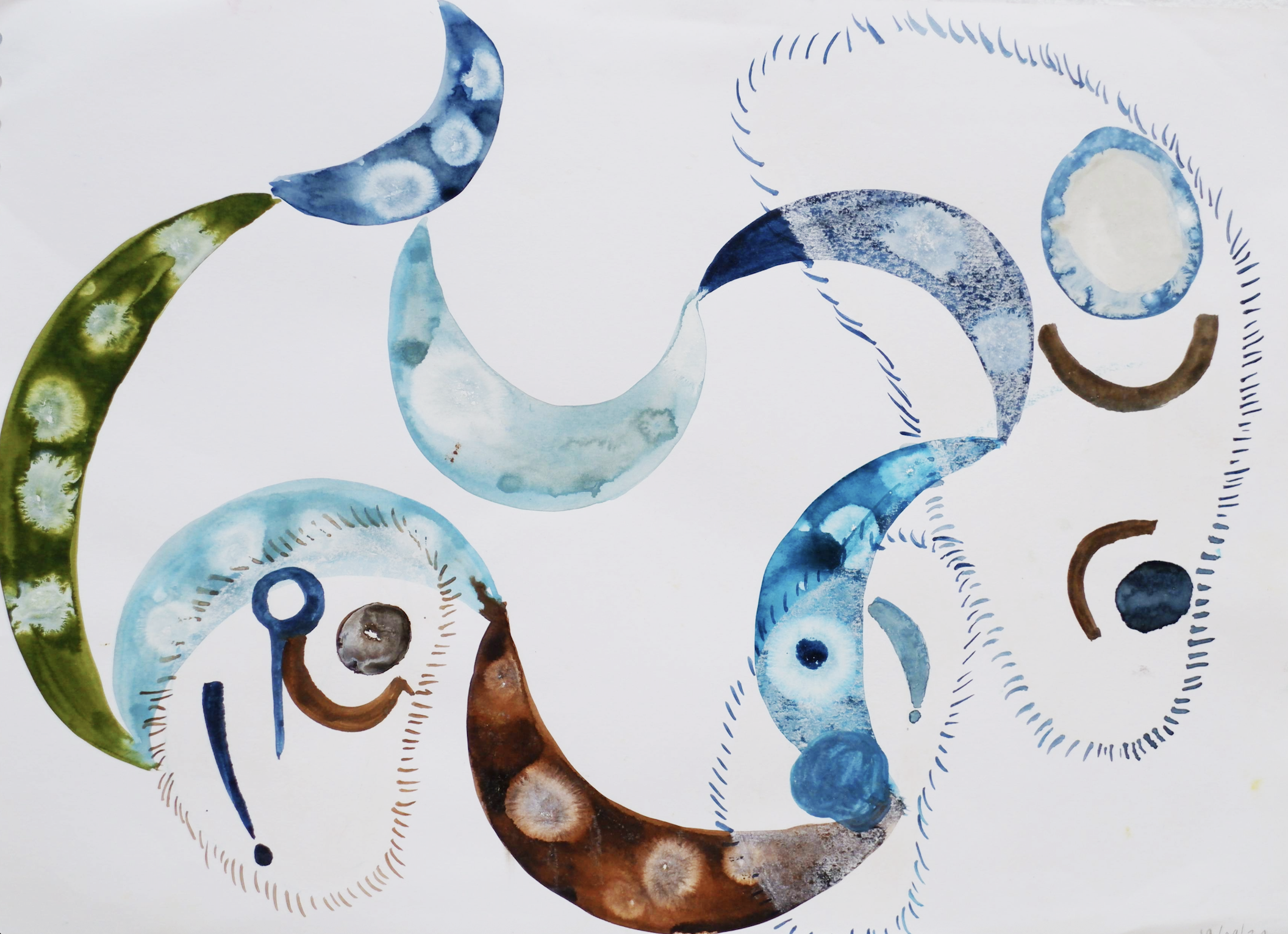
Planetary agencies shape politics
A growing body of evidence shows that Earth is not simply the “environment” humans inhabit or a “system” we manage. Instead, scientists, artists, and civic actors increasingly understand the planet as shaped by diverse agencies, from the slow churn of tectonic plates to the self-organizing intelligence of microbial colonies and the feedback loops of climate-modifying technologies. The planet is not inert. It acts and shapes the conditions under which political life unfolds. Every day.
The planet is not inert. It acts and shapes the conditions under which political life unfolds. Every day.
One striking example is the atmospheric disruption caused by the eruption of Mount Tambora in 1815, which triggered crop failures, famines, and political unrest from Europe to Asia. No single factor but rather many interacting agencies—volcanic activity, climatic shifts, microbial outbreaks, and societal processes—created these outcomes. Today, our volcanic entanglements have only intensified. The human-accelerated melting of ice shields may also increase volcanic activity beneath them, as historical patterns in Iceland suggest.
In this context, defining politics as the exclusive domain of governments and the primary realm of law or deliberation is inadequate; rather, politics must more broadly encompass all aspects and matters related to our planetary condition. Yet dominant political imaginaries still center human actors and the collectives they form. Not surprisingly, concepts such as sovereignty, rights, or citizenship begin to fray when the political field expands to include the agency of coral reefs, solar winds, or synthetic organisms.
It is possible to take planetary agencies into account without personifying or romanticizing them and instead develop political sensibilities capable of responding to all Earth-shaping forces, whether human, more-than-human, or technological. Across the world, heat waves intensify, glaciers vanish, and microbial life resurfaces in thawing permafrost. These agencies manifest through patterns, pressures, and signs. Agency is thus not will, intelligence, or intention. It is simply the capacity to make a difference in the world.
Attunement to planetary semiotics
Governing with the planet rather than over it requires a shift in perception. Instead of asking who speaks for nature, we must ask how planetary agencies signal, act, and shape the conditions of political life. How do we sense and engage with them and include them in decision-making, not metaphorically but concretely?
This approach challenges a centuries-old political grammar grounded in human exceptionalism. It asks us to take seriously the communicative capacities of forests, glaciers, rivers, bacteria, and even sensors and satellites. This involves recognizing these meaning-making beings and entities as actors shaping our planetary condition and not mere data sources. Yet current politics remain largely deaf to these signals. The planet, however, is not silent. It speaks, signals, and resists.
Politics, then, must begin with planetary semiotics: the study of how meaning circulates among humans and other planetary agencies across time, space, and matter. More-than-human agencies often do not “speak” in words, but they do exchange information. Coral bleaching signals ecological distress. Rising CO₂ levels trigger plant responses that reshape ecosystems. AI-driven sensors now detect deep-earth shifts before humans can perceive them. If we cultivate political sensitivity and institutional imagination, we can sense, interpret, and respond to these signs.
Politics, then, must begin with planetary semiotics: the study of how meaning circulates among humans and other planetary agencies across time, space, and matter.
Some initiatives gesture in this direction. Most prominently, Ecuador’s constitution recognizes the rights of nature. Māori cosmology and law informed the grant of legal personhood to the Whanganui River in Aotearoa New Zealand. Yet these efforts often rely on lawyers, scientists, Indigenous spokespersons, and other human proxies to act on behalf of or represent planetary entities. What remains underdeveloped is a politics that directly accounts for planetary agencies as shaping forces. This requires forms of sensing—ranging from embodied to technological—that are distributed, multimodal, and capable of recognizing agency as it unfolds.
One recent experiment, building on the Brazilian Rio Sagrado Avatar as a precursor, is the Lahn River Avatar in Giessen, Germany. This transdisciplinary, AI-powered figure gives the river a mediated voice by merging environmental data, historical narratives, and cultural memory. It doesn’t speak for the river but with it, channeling its conditions and entanglements. These prototypes reveal one approach to apprehending planetary agencies as active participants without reinforcing extractive or anthropocentric logics.
Three shifts toward planetary responsiveness
1. The planet moves first
Planetary politics must begin with relational and distributed agencies. These emerge through interaction: between tectonic activity and atmospheric circulation, between microbial evolution and industrial agriculture, between planetary computation and ecological collapse. Agency is not a possession. It is enacted. And in recognition, politics must shift away from managing actors and toward responding to forces already in motion.
2. Institutions that can listen
Instead of folding the more-than-human into existing institutions through representation or legal proxies, we need new political architectures capable of responsiveness. These may include planetary observatories, multispecies assemblies, or long-term forums that work across epistemologies and temporal scales. We do not need symbolic gestures but rather institutional forms open to thresholds, signals, and shifting conditions. Experimentation is key.
3. Learning to navigate a restless Earth
Our planetary condition is dynamic. Politics must move from governing for stability to navigating change. This requires attunement to signs—from glacial retreat to coral bleaching and sensor anomalies—that serve as early expressions of shifting planetary agencies. To respond wisely demands epistemic humility: a willingness to act amid uncertainty and to learn from modes of knowing beyond the human.
Toward a politics of planetary habitability
Humans are part of this entangled condition as both agents and recipients of agency beyond our control. We help generate the planetary condition to which we must respond. To ignore the agencies that act through and around us is to govern blindly. To sense them and act accordingly is to reorient politics toward planetary habitability and the conditions for political freedom.
This invokes what I call a planetocracy: a reimagined democracy accountable to human publics and responsive to planetary agencies. Planetocracy is not about extending rights to every stone or satellite but instead prioritizes cultivating the institutional capacity to interpret signals of planetary agencies and act on them to preserve freedom and shared flourishing with a dynamic Earth.

